
Riester pension vs. Altersvorsorgedepot (Germany’s state-subsidized retirement investment account): switch or stay?
From 1 January 2027 the Riester pension will be replaced by the Altersvorsorgedepot as the new subsidized retirement product. New contracts will then no longer be possible, existing contracts but continue under grandfathering. We compare the most important differences and tell you when switching makes sense.
Table of contents
What is the Riester pension?
The Riester pension is a private retirement provision in Germany that has been state-subsidized since 2002. It combined an annual basic allowance of €175, child allowances, a special expenses deduction and, as the problematic element, a mandatory 100% contribution guarantee.
Riester pension vs. Altersvorsorgedepot compared
| Feature | Riester pension | Altersvorsorgedepot |
|---|---|---|
| basic allowance | €175 (fixed) | up to €540 (proportional) |
| child allowance | €185 (born before 2008) / €300 | €300 / child |
| contribution guarantee | 100% mandatory | 0, 80 or 100%, voluntary |
| Investing | often insurance / guarantee pot | ETFs, funds, bonds |
| Reduction in yield | typically 1.5–2.5% | max. 1% (default standard product) |
| payout | life annuity mandatory | choice: life annuity or drawdown plan up to 85 |
| Self-employed | not directly eligible for the subsidy | eligible for the subsidy |
| career starter bonus | €200 (one-off) | €200 (one-off, similar) |
What happens to my Riester contract from 2027?
Existing contracts continue unchanged; new contracts will no longer be available from 2027.
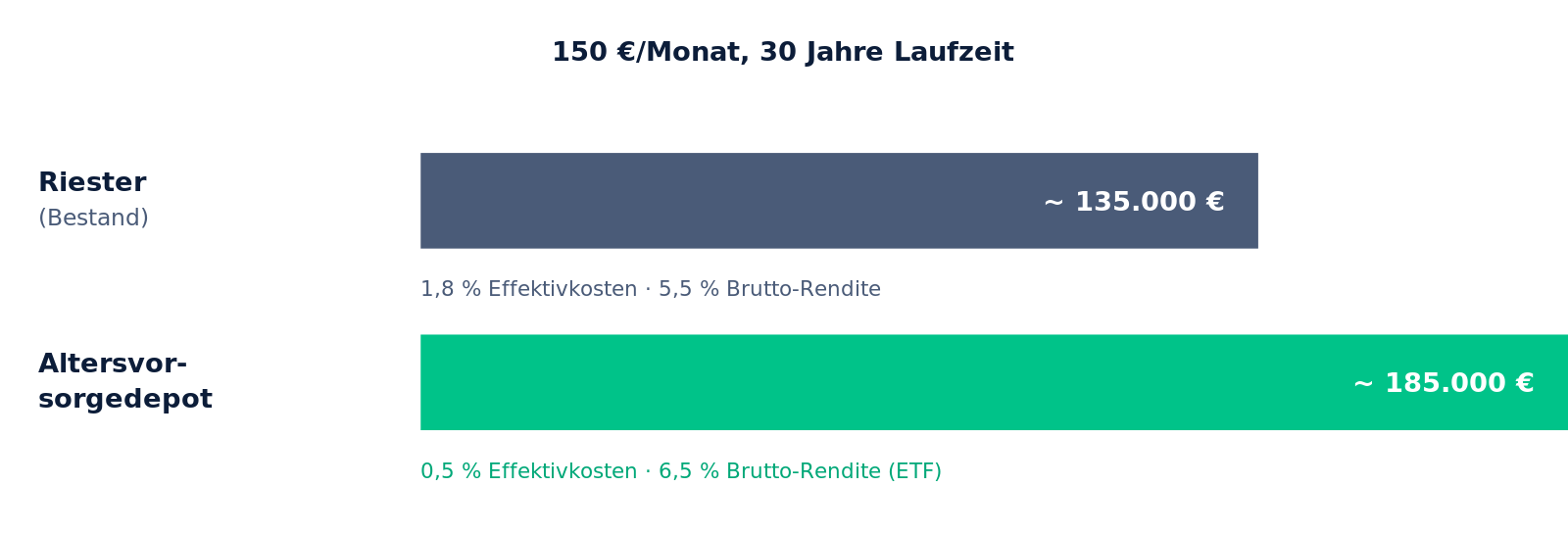
Final balance after 30 years: Riester vs. Altersvorsorgedepot
Grandfathering: what happens to old contracts?
Riester contracts concluded before 1 January 2027 may continue to be funded, including all subsidies received so far. You can also:
- stop contributions (no payments in, no allowances),
- terminate the contract (non-qualifying, all allowances and tax advantages have to be repaid),
- transfer it to an Altersvorsorgedepot (the subsidized capital is retained).
When is switching worth it?
Switching is particularly worthwhile if your Riester contract has one or more of these features:
- High reduction in yield (RIY) (> 1.5%).
- Low return so far or a negative real return.
- Inflexible payout rules.
- Long remaining term (> 15 years), in which case the switch will definitely pay for itself.
Better not to switch if:
- You are very close to the start of your pension.
- You have a particularly favorable old commitment (a high guaranteed interest rate).
- Wohn-Riester was used for a property.
How switching works
- Choose a new Altersvorsorgedepot provider.
- Submit the transfer request there; the new provider takes care of the rest.
- The old provider transfers the balance plus allowances (max. €150 fee in the first 5 years).
- The new subsidy terms apply from the start of the contract with the new provider.
Switch or stay? Three practical examples
Sabine, 35, Riester fund savings plan since 2008. Reduction in yield (RIY) of 1.9%, remaining term ~30 years. Switching to an ETF Altersvorsorgedepot with a reduction in yield of 0.5%: with the same contribution and a 6% gross return she gains, over 30 years, around €40,000 in additional capital. Switching is clearly worth it.
Hans, 58, classic Riester insurance since 2002. High guaranteed interest rate (2.75%), profit participation already built in, remaining term 9 years. Switching would mean high surrender costs and market risk in the final phase. Recommendation: let the contract run.
The Krause family, Wohn-Riester for their own home. A residential subsidy account cannot be transferred into an Altersvorsorgedepot. Recommendation: continue Wohn-Riester unchanged and open an additional new Altersvorsorgedepot alongside it.
Additional return from switching, model calculation
| Scenario | Reduction in yield | Gross return | Final balance after 30 years |
|---|---|---|---|
| Old Riester | 1.8% | 5.5% | ~€135,000 |
| Altersvorsorgedepot | 0.5% | 6.5% | ~€185,000 |
| Difference | +€50,000 |
Model calculation with a €150/month contribution. Excluding switching fees and taxes.
Switching checklist
- Check the reduction in yield (RIY) of your old contract in the product information sheet.
- Check the guaranteed interest rate (old contracts from before 2012 often > 2%).
- Read off the capital accumulated so far plus the allowances received from your last allowance notice.
- Determine the remaining term until the start of your pension.
- Choose a new provider (bank, neobroker, insurer) and submit a transfer request.
- The transfer takes 8–12 weeks; the old provider may charge no more than €150.
- With the new provider, set up an ETF savings plan and issue the permanent allowance application.
Frequently asked questions: Riester vs. Altersvorsorgedepot
Can I transfer Wohn-Riester into an Altersvorsorgedepot?
No. The specifics of Wohn-Riester (the residential subsidy account) cannot be carried over into the new model. The existing Wohn-Riester continues under grandfathering.
What does “non-qualifying termination” mean?
A termination in which the state subsidy is lost. All allowances and tax advantages received have to go back to the tax office.
Is switching worth it for older savers shortly before retirement too?
Rarely; the short remaining term cannot make up for the effort of switching and possibly higher volatility.
How long does a switch take?
Typically 8–12 weeks. The new provider handles most of it; you do not need the old provider’s consent.
Is the old subsidy retained?
Yes. All allowances and tax advantages received so far are transferred along with the balance.
What if the old provider digs in its heels?
By law it may not block the switch. If there are problems, BaFin (Federal Financial Supervisory Authority) is the complaints body.
Can I let Riester continue and open an Altersvorsorgedepot alongside it?
Yes. Both contracts are possible side by side. However, the allowances can only be claimed once per person.
What happens with Wohn-Riester if there is a remaining loan?
Wohn-Riester continues until the decumulation phase. The deferred taxation of the residential subsidy account remains in place.
Do existing Riester contracts continue to earn interest?
Yes, at the guaranteed interest rate agreed in the contract plus any profit participation.
Is switching to the AVD worth it?
Switching to the AVD is voluntary, costs at most €150 and can be worthwhile with modern contracts.
Last updated: June 2026.
Keep calculating and reading
Altersvorsorgedepot calculator Plus — calculate the subsidy, tax advantage and final balance for your own situation.
All terms at a glance: Glossary from A to Z.
Official sources and further information
- Federal Ministry of Finance, FAQ on the reform of private retirement provision
- German federal government, private retirement provision reform
- German Bundestag, resolution on the Altersvorsorgedepot (calendar week 13/2026)
- Bundestag printed paper 21/4088 (PDF)
- Deutsche Rentenversicherung, reform announcement
- Stiftung Warentest, Altersvorsorgedepot
- Verbraucherzentrale, the new Altersvorsorgedepot: opportunity or sales trap?