
Deferred taxation in the Altersvorsorgedepot
The Altersvorsorgedepot follows the principle of deferred taxation: contributions receive tax relief today, while payouts in retirement are taxed at your personal income tax rate . Ideally you save tax today at a high rate and pay tax later at a low one.
Table of contents
What does deferred taxation mean?
The opposite of up-front taxation: tax is levied not when you pay in, but only when money is paid out. This principle already applies to the statutory pension, the Rürup pension and occupational pension schemes. With the Altersvorsorgedepot it now also enters private securities-based retirement provision.
How does it work in practice in the Altersvorsorgedepot?
| Phase | What happens for tax purposes? |
|---|---|
| Accumulation phase | Contributions of up to €1,800 are deductible; no ongoing taxation of price gains. |
| Transition phase | A one-off withdrawal of up to 30% is possible (taxable). |
| Decumulation phase | Monthly pensions are taxed at your personal income tax rate. |
When do I have to pay tax on the AVD?
Tax-free during the accumulation phase, taxed in retirement. That pays off because the tax rate in retirement is usually lower.
Sample calculation: the tax leverage
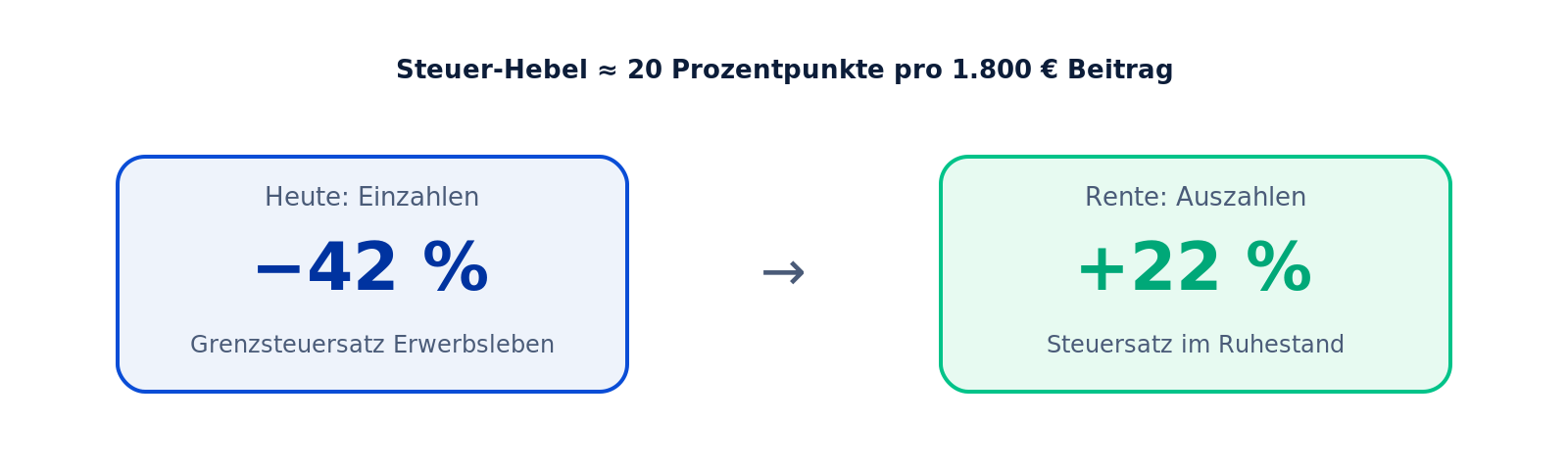
Phase 1, accumulation (tax rate 42%): you pay €1,800 into the securities account. The assessment base is €2,340, that is €1,800 plus the allowance entitlement. Through the special expenses deduction you get around €983 of that back in tax savings.
Phase 2, payout (tax rate 22%): you pay tax on the same amount later at 22% instead of 42%. Pure tax saving per contribution year: around €468 (a difference of 20 percentage points on €2,340).
Tax leverage: save today, pay tax later
Why does this principle exist?
First, because pension income in old age is typically lower than earned income, so a more favourable tax rate applies. Second, because deferring tax over decades provides an interest-like advantage : the capital that would otherwise be taxed immediately keeps working and earns an additional return.
Pitfalls and special cases
- In the case of a non-qualifying withdrawal before the age of 65, allowances and tax advantages have to be repaid.
- Anyone who moves abroad (outside the EU/EEA) may also be required to repay them.
- The one-off withdrawal of up to 30% is taxed in full in the year of payout.
Three everyday tax examples
Top earner Klaus, 50, €110,000 gross, 42% marginal tax. Contribution €1,800 a year, assessment base €2,340. Immediate tax saving around €983. In retirement, at an expected tax rate of 22%, he pays tax on the later pension, giving tax leverage of around €468 per contribution year.
Mid earner Petra, 35, €45,000 gross, 30% marginal tax. Contribution €1,800 a year. Tax saving €540 = exactly as much as the basic allowance. The more-favourable-treatment check selects the allowance. In retirement her tax rate is expected to be 18%, giving tax leverage of about €216 per contribution year.
Low earner Aysel, 27, €22,000 gross, 14% marginal tax. Contribution €600 a year. Tax saving €84. Basic allowance €240, clearly better. In retirement she is not expected to have taxable income, so the later pension will be almost tax-free when it is paid out.
Health insurance in the pension phase
Members with compulsory cover under the statutory health insurance scheme for pensioners are expected to pay none contributions on payouts from the Altersvorsorgedepot. People voluntarily insured under the statutory scheme do pay, because there all income is used to assess contributions. Privately insured people are not affected, as their premiums do not depend on income. If you are voluntarily insured under the statutory scheme, you should factor this into your overall return.
Tax deferral as a hidden compounding booster
The often overlooked effect of deferred taxation: during the accumulation phase the tax money stays in the securities account and earns a return of its own. Over 30 years this can raise the final balance by an additional 10–15% compared with up-front taxation during your working life.
Frequently asked questions about deferred taxation
Are price gains in the securities account taxed?
No, only on payout. Vorabpauschale (advance lump-sum taxation) and flat-rate withholding tax on investment income do not apply during the accumulation phase.
Is the payout really cheaper later on?
In most cases yes, because income in retirement is lower. Very high pensions or lump-sum payouts can weaken the effect, though.
What about the health insurance scheme for pensioners?
That depends on your insurance status. Compulsory members of the KVdR are expected to pay nothing. People voluntarily insured under the statutory scheme do pay, because there all income counts. Privately insured people are not affected, as private health insurance premiums are independent of income.
Does the basic tax-free allowance apply to the later taxation?
Yes. Up to the level of the basic tax-free allowance (2026: €12,084 per person, adjusted in later years) the payout stays tax-free.
What happens with a one-off withdrawal (30%)?
It is fully taxable in the year of payout. The one-fifth rule does not apply, so plan carefully.
How does inflation affect this?
Pensions are taxed in nominal terms, and inflation erodes purchasing power. The real tax leverage is therefore smaller than the nominal one.
What happens if I emigrate?
Within the EU/EEA the subsidy is retained. If you move to a third country, the subsidy can be reversed.
Is a partial payout at the start of retirement worth it?
A partial payout of up to 30% at the start of retirement can make sense, but it is taxable.
Last updated: June 2026.
Keep calculating and reading
Altersvorsorgedepot calculator Plus — calculate the subsidy, tax advantage and final balance for your own situation.
All terms at a glance: Glossary from A to Z.
Official sources and further information
- Federal Ministry of Finance, FAQ on the reform of private retirement provision
- German federal government, private retirement provision reform
- German Bundestag, resolution on the Altersvorsorgedepot (calendar week 13/2026)
- Bundestag printed paper 21/4088 (PDF)
- Deutsche Rentenversicherung, reform announcement
- Stiftung Warentest, Altersvorsorgedepot
- Verbraucherzentrale, the new Altersvorsorgedepot: opportunity or sales trap?