
Reduction in yield (RIY) in the Altersvorsorgedepot: what you need to know
The reduction in yield (RIY) shows by how many percentage points the annual return on a securities account is reduced by all fees together and it is the most important figure for comparing offers honestly. With the default standard product it is capped at a maximum of 1% per year per year.
Table of contents
What is the reduction in yield?
The reduction in yield, formally known as Reduction in Yield (RIY), is a consumer-friendly metric. It translates all the fees of a retirement product into a single percentage figure: How much return does this product cost me per year? With a 6% gross return and a 1% reduction in yield, 5% net reaches you.
Which costs go into the reduction in yield?
- Acquisition and distribution costs
- Administration and securities account costs
- Fund costs (TER of the ETFs / funds held)
- Transaction costs / front-end loads
- Costs of the decumulation phase (pension administration)
How strongly do costs affect the return?
The reduction in yield is the most important lever when comparing providers. 0.5% versus 1.5% makes a five- to six-figure difference over 30 years.
How high is the reduction in yield typically?
| Product type | Reduction in yield p.a. |
|---|---|
| ETF default standard product (bank/neobroker) | 0.3–0.7% |
| Default standard product with active funds | 0.7–1.0% |
| Premium product with advice | 1.0–1.8% |
| For comparison: an old Riester contract | 1.5–2.5% |
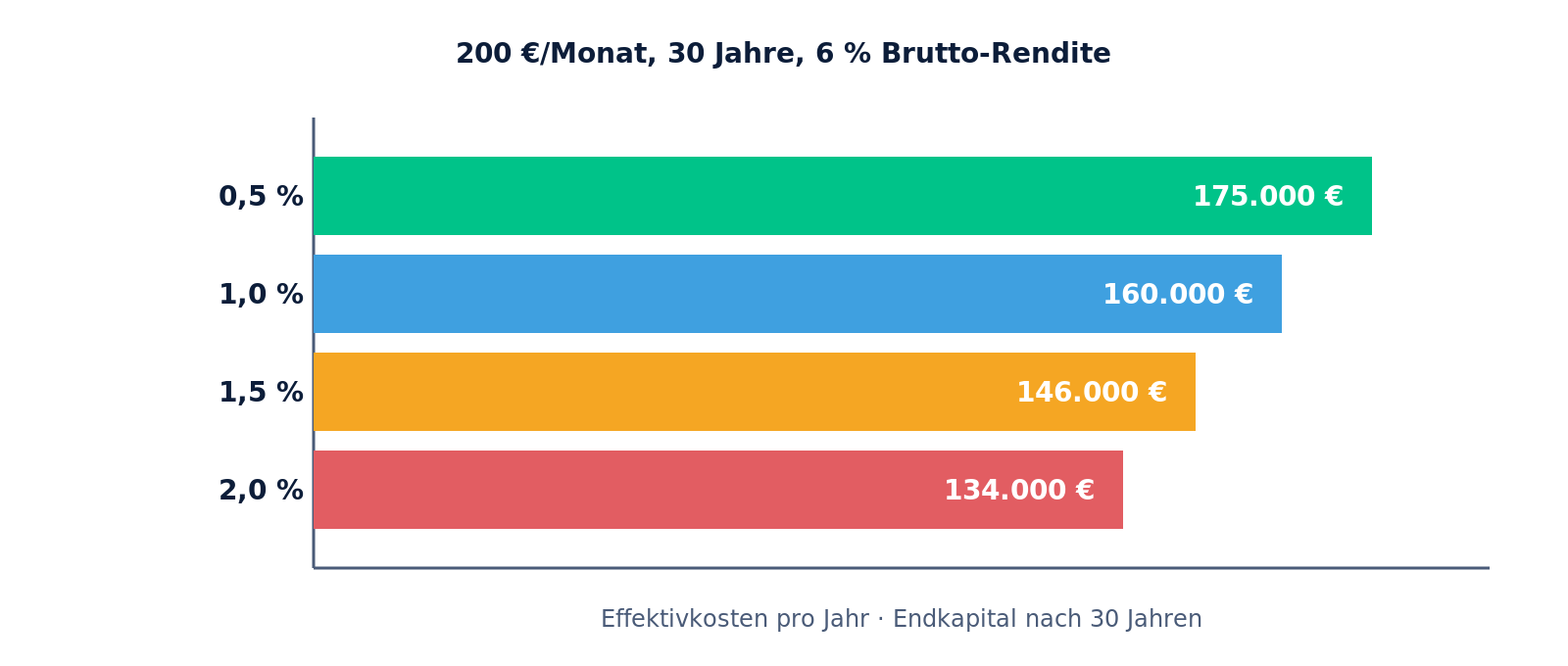
Final balance after 30 years, depending on the reduction in yield
Why is the reduction in yield so important?
Because over decades it works exponentially on your money. One percentage point less in costs does not mean 1% more final balance but thanks to compound interest quickly 20–30%.
Model calculation: 30 years of saving
€200 per month own contribution, 6% gross return, 30-year term:
| Reduction in yield | Net return | Final balance |
|---|---|---|
| 0.5% | 5.5% | ~ €175,000 |
| 1.0% | 5.0% | ~ €160,000 |
| 1.5% | 4.5% | ~ €146,000 |
| 2.0% | 4.0% | ~ €134,000 |
Model calculation, excluding allowances and Tax. Difference between a cheap and an expensive product: ~ €40,000.
How costs play out in practice
Anna vs. Bernd, both 30, €150/month, 30-year term, 6% gross:
Anna chooses an ETF default standard product with a 0.4% reduction in yield, final balance around €178,000.
Bernd chooses a traditional insurance policy with a 1.7% reduction in yield, final balance around €132,000.
Difference from costs alone: €46,000.
Frequently asked questions about the reduction in yield
Where do I find the reduction in yield?
Every provider has to disclose it clearly in the product information sheet . You will often find two figures: one for 12 years and one for the full term.
Are the reduction in yield and the TER the same thing?
No. The TER (Total Expense Ratio) covers only the fund costs. The reduction in yield covers all costs: the TER plus acquisition, administration and the pension account.
Is a 1% reduction in yield a lot?
It is the statutory upper limit for the default standard product. Pure ETF accounts often manage considerably less. Premium products are frequently above it.
How can I lower the reduction in yield?
Choose a provider with an ETF default standard product and pay no advice commission.
Is 0.3% the technical minimum?
Pure neobrokers with ETFs below 0.1% TER could offer a reduction in yield of under 0.3% from 2027.
Does the 1% cap also apply to the decumulation phase?
Yes, the costs of the pension phase are included in the reduction in yield and therefore have to stay below the cap.
What should I look out for when comparing?
Default standard products are capped by law, premium products can be more expensive. It pays to read the small print.
Last updated: June 2026.
Keep calculating and reading
Altersvorsorgedepot calculator Plus — calculate the subsidy, tax advantage and final balance for your own situation.
All terms at a glance: Glossary from A to Z.
Official sources and further information
- Federal Ministry of Finance, FAQ on the reform of private retirement provision
- German federal government, private retirement provision reform
- German Bundestag, resolution on the Altersvorsorgedepot (calendar week 13/2026)
- Bundestag printed paper 21/4088 (PDF)
- Deutsche Rentenversicherung, reform announcement
- Stiftung Warentest, Altersvorsorgedepot
- Verbraucherzentrale, the new Altersvorsorgedepot: opportunity or sales trap?