
Vanguard on the Altersvorsorgedepot: costs, competition and the 2027 launch
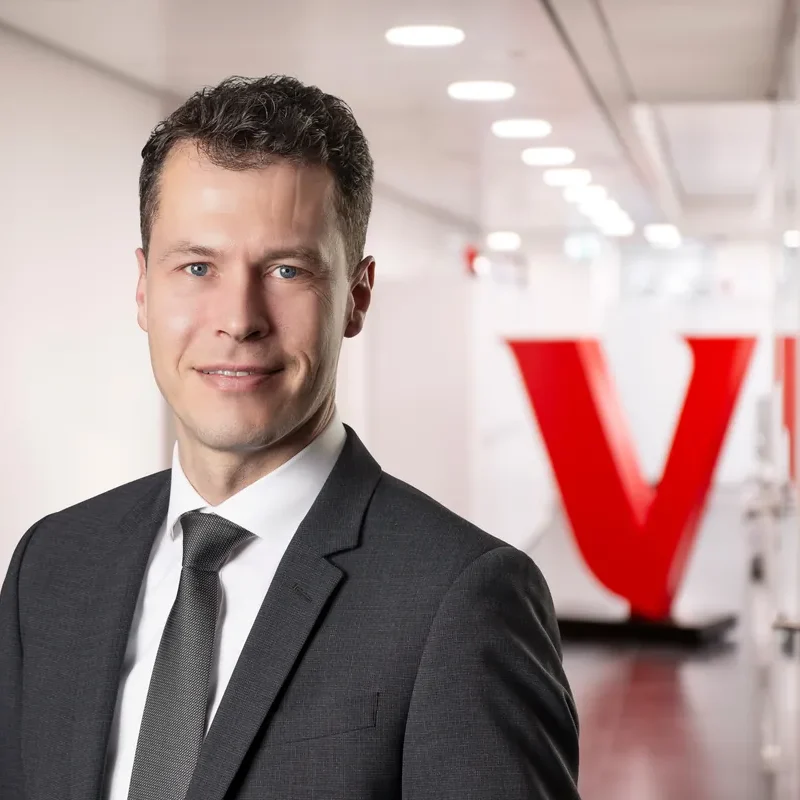
Fabian Behnke, Head of Strategic Accounts at Vanguard
10 questions for Fabian Behnke of Vanguard – an expert interview
From 1 January 2027 the Altersvorsorgedepot replaces the Riester pension as the core state-subsidized product. How the provider side views the new rules has barely reached the outside world so far. So we asked. Fabian Behnke, Head of Strategic Accounts at Vanguard, talks in this interview about the 1.0% cost cap, the cooperation with Growney, the Frühstartrente and the points where, in his view, legislators need to make improvements.Fa
Öffnet den Artikel mit fertigem Prompt in:
ChatGPT Claude Perplexity Google AI Mode GrokEs werden keine Daten an Dritte übertragen, bevor Sie klicken.
1. Vanguard stands for low-cost, passive investing. How do you assess the statutory upper limit of 1.0% on the reduction in yield (RIY) for the standard securities account?
Low costs are a central success factor for long-term investment and ensure that the government subsidy reaches investors as efficiently as possible. Unlike a portfolio’s performance, costs can be controlled well, and every cent that goes into fees may be missing from your pension in the end. Together with our cooperation partners we will offer default standard products that are both fair for investors and attractive in the long term for advice and for the partner. From our point of view the cost cap is therefore not a problem.
At the same time, the political objective should not be reduced to securities account administration alone. Financial education, digital infrastructure, customer communication and, where applicable, advice also cause costs. That is why we consider the additional ban on acquisition and distribution costs for the Frühstartrente unnecessary, since the cost cap already protects against unreasonably high costs.
2. With Growney you have already won a concrete partner for ETF model portfolios in the Altersvorsorgedepot. What does Vanguard’s role in the market look like?
Vanguard sees its role above all in supporting the build-up of low-cost, long-term, capital-market-based retirement provision in Germany. In doing so we draw on our global expertise, which we have gathered over decades as one of the largest providers of retirement solutions in the US, the UK and Australia. In Germany, too, we now offer model portfolios and, together with our partners, discretionary portfolio management based on model portfolios, which are outstandingly suited to the Altersvorsorgedepot and are readily used by advisers and intermediaries.
The concrete design of possible distribution or cooperation models will develop further over the coming months and will be guided by the regulatory framework. There are still open questions here that legislators need to clarify. What is decisive from our point of view is that enough providers are able to develop attractive solutions and that competition and the capacity for innovation are safeguarded, so that investors get the best offer.
3. Does the investment universe limit the ability to offer genuinely broadly diversified global portfolios?
We have no fundamental criticism of the planned product range. On the contrary: we have compared various international retirement models and found that at the heart of successful models are broadly diversified, cost-efficient, globally oriented fund investments of the kind that are also possible in Germany under the current framework. At the same time, investors retain sufficient freedom of choice, which should support acceptance of the reform without taking on excessive risks. What remains decisive is that investors inform themselves about their retirement provision as far as possible and make their own decision – that not only increases financial literacy but can also raise long-term acceptance.
4. How do you assess the competition between private ETF-based solutions and a state offering?
We fundamentally see private offers and a state fallback solution as complementary building blocks. With a purely state solution there is a risk that important goals such as financial education and the build-up of long-term capital market experience will only be met to a limited extent. Private providers can make an important contribution through digital access, transparent terms and continuous support and advice, bringing more people to the capital markets – also beyond state-subsidized retirement provision. The state fallback solution has to be designed in such a way that fair competition is preserved.
5. Is the Altersvorsorgedepot a turning point for Germany’s equity culture?
The Altersvorsorgedepot has the potential to make an important contribution to broader capital market participation in Germany. The combination of wealth building and financial education is particularly valuable. International experience shows that people save and invest on a lasting basis more often when they gain practical experience with capital market investments early on. Whether this results in a genuine turning point will, however, depend largely on how attractive, understandable and accessible the offers are designed to be and on whether financial education is consistently promoted.
6. How do you assess the interplay between the Altersvorsorgedepot and the Frühstartrente?
From our point of view the two instruments complement each other very sensibly. The Frühstartrente creates the opportunity to combine wealth building and financial education as early as childhood and to lay important foundations for later retirement provision – in particular through the option of private additional payments. The planned transition into private retirement provision in adulthood ensures that early capital market experience can be continued over the long term. In international comparison we observe that precisely this continuous savings and retirement path is particularly effective.
7. Which international experiences can be transferred to Germany?
International success models share several common features regardless of the country concerned: entry into wealth building as early as possible, broad accessibility, the option of additional private payments, attractive tax incentives, and a simple transition into long-term retirement products. So far, Germany differs among other things through comparatively low capital market participation and a historically grown reticence towards equity-based retirement solutions, which has to be dismantled if the reform of retirement provision is to succeed. That is precisely why advice, financial education and simple, low-cost standard solutions are particularly important.
8. How is the relationship between execution-only offers and advised intermediation changing?
The statutory framework assumes that no advice is required in the standard securities account in its present form. That supports efficient and low-cost processes, especially for those who have already been able to gain capital market experience. At the same time, international examples show that good, holistic advice and ongoing support can make an important contribution to financial education, trust and long-term investment behavior, and can be essential particularly for people investing for the first time. We therefore expect that both digital execution-only offers and advice-supported solutions will have their place in the market and that overall more eligible people will be reached than in the past. What is decisive is that consumers are given a suitable choice.
9. Is there enough time until 2027?
The industry is already working intensively on the preparations, but not all providers will have a finished offer by 1 January 2027. From our point of view the success of these preparations will depend largely on the regulatory framework being finalized in good time and on providers having sufficient planning certainty. Then competitive products, digital processes and viable partnerships can be built in time. At the same time it is important to remind investors that they should not let themselves be put under pressure and do not have to choose the first product that comes along: the decision on a suitable retirement solution can also be made in the second half of 2027 – without having to forgo the subsidy.
10. What would policymakers still need to sharpen up?
The reform approach presented is an important step towards strengthening private retirement provision in Germany. At the same time, we see a number of areas in which the framework could be improved further.
First, the transition from the Frühstartrente into the Altersvorsorgedepot should be designed to be as seamless and uncomplicated as possible. The greatest added value arises when children and young people gain their first experience with the capital market early and can later transfer this wealth building into private retirement provision without bureaucratic hurdles. In this way a continuous retirement path can emerge across an entire lifetime.
Second, financial education should become an even stronger component of the overall concept and should also be taken into account in the state fallback solution. People make better retirement decisions when they understand how long-term wealth building works, what role risk and diversification play, and what influence costs have on investment success. Financial education is therefore not a side issue but a central prerequisite for the long-term success of the reform.
Third, we see a further need for reform in occupational retirement provision. Here, too, Germany needs more capital-market-based retirement solutions. From our point of view this includes less rigid guarantee requirements as well as more flexibility for employers in implementation, for example through the use of the Altersvorsorgedepot.
Overall, the goal should be to think about costs, accessibility, competition, financial education and long-term capital market participation together. Then the Altersvorsorgedepot has the potential to strengthen private retirement provision lastingly and to bring more people in Germany closer to the capital market.
What does the Altersvorsorgedepot give you?
Subsidy, tax advantage and potential account value in under a minute, using your own figures.
About the expert
Fabian Behnke
Head of Strategic Accounts, Vanguard
As Head of Strategic Accounts at Vanguard, Fabian Behnke leads a team that looks after insurers, strategic clients and partnerships in Germany and Austria. Previously he worked at an international bank in the derivatives area and in asset management, serving professional investors. He has more than 20 years of experience in the German-speaking ETF market