
Altersvorsorgedepot
The Altersvorsorgedepot (Germany’s state-subsidized retirement investment account) is a state-subsidized securities account for private retirement provision in Germany. It launches on 1 January 2027 and replaces the Riester pension. Savers invest in ETFs, stocks, funds or bonds and in return receive government allowances or a special expenses deduction.
Table of contents
- What is the Altersvorsorgedepot?
- Who can open an Altersvorsorgedepot?
- When does the Altersvorsorgedepot start?
- How does the Altersvorsorgedepot work?
- How much subsidy is there?
- Why does it replace the Riester pension?
- Model calculations: how different savers benefit
- Which providers are there?
- Advantages and disadvantages at a glance
- Tax strategy
- Common mistakes
- Frequently asked questions
What is the Altersvorsorgedepot?
The Altersvorsorgedepot is a certified retirement provision contract, which works like an ordinary securities account, with the difference that the state subsidizes the saving and grants tax relief. Savers can pay in money flexibly (also via a regular savings plan) and invest the capital worldwide in stocks, exchange-traded index funds (ETFs), traditional investment funds or bonds.
The key change compared with Riester: the 100% contribution guarantee is abolished. Savers can deliberately opt for high-return equity ETFs and no longer have to park most of their money in low-yielding guarantee pots. Anyone wanting security can optionally choose a Guarantee product or the cost-capped default standard product.
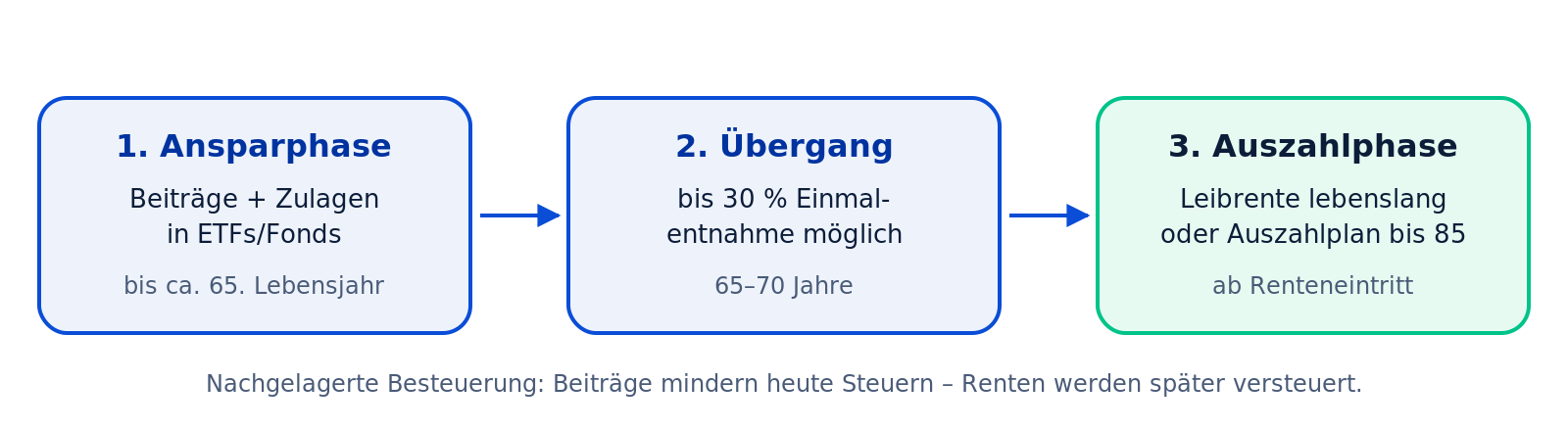
The three phases of the Altersvorsorgedepot
Who can open an Altersvorsorgedepot?
The group of people eligible for the subsidy has been significantly widened. Eligible are:
- Employees and workers, who have compulsory cover in the statutory pension insurance.
- Civil servants, judges and career soldiers (with consent to the data exchange between the public-sector employer and the ZfA).
- Self-employed people and freelancers, for the first time even without compulsory cover in the statutory pension.
- Compulsory members of professional pension schemes (e.g. doctors, lawyers, tax advisors).
- Children and young people through the Frühstartrente (early-start pension for children).
What does the Altersvorsorgedepot actually deliver?
At its core the AVD is a securities account with government subsidy. More return potential than Riester, less compulsory guarantee.
When does the Altersvorsorgedepot start?
The statutory launch date is 1 January 2027. The Retirement Provision Reform Act was passed by the Bundestag on 27 March 2026, and the Bundesrat approved it on 8 May 2026. From that date providers (banks, neobrokers, fund companies, insurers) may distribute certified products. The Frühstartrente also starts on 1 January 2027. No contract can be signed before then, and there is no transitional rule for 2026.
How does the Altersvorsorgedepot work?
The contract runs through three phases:
| Phase | What happens? | Subsidy |
|---|---|---|
| Accumulation phase | Pay in contributions, invest in ETFs / funds. | Allowances + tax advantages |
| Transition (65–70) | Choice of payout format. | Up to 30% partial lump-sum withdrawal with tax relief |
| Decumulation phase | life annuity or drawdown plan to age 85. | Deferred taxation at your personal tax rate |
During the accumulation phase the capital in the securities account is protected from state access and cannot be seized (similar to Riester). An early payout is possible, but then all allowances and tax advantages received have to be repaid.
How much subsidy is there?
Unlike with Riester, the allowance is proportional to the contribution:
| Own contribution per year | Allowance rate | Maximum allowance |
|---|---|---|
| up to €360 | 50% per euro | €180 |
| €360.01, €1,800 | 25% per euro | + €360 |
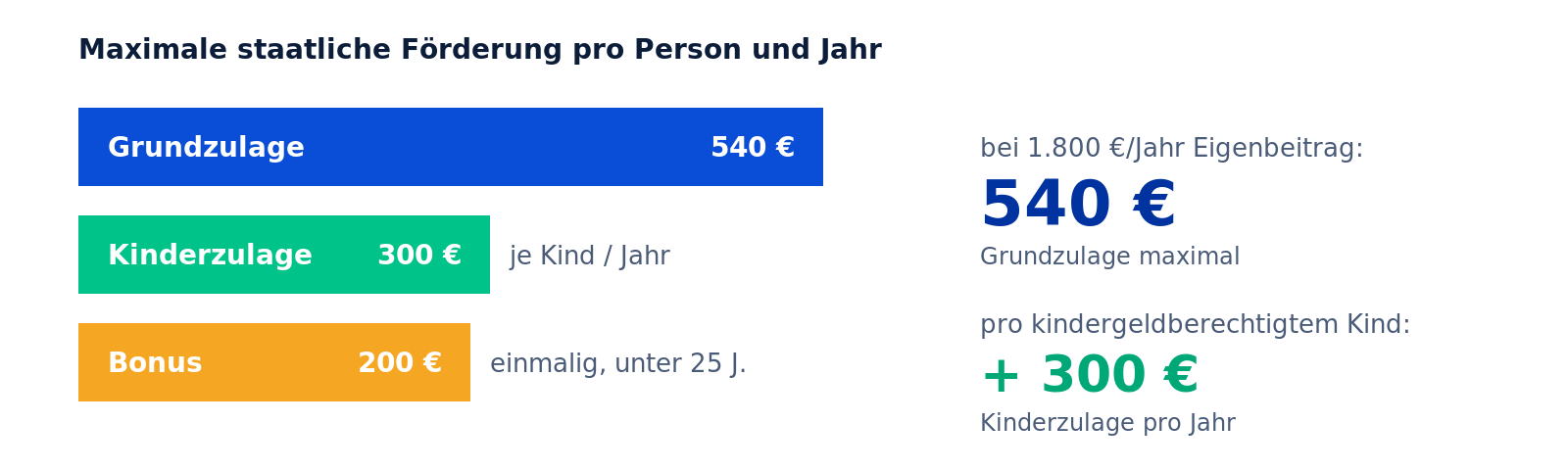
| Maximum | – | €540 basic allowance |
| + per child (eligible for child benefit) | 100% up to €300 own contribution | €300 child allowance |
| + career starter bonus (one-off, under 25) | – | €200 |
Anyone with a higher tax rate can additionally deduct €1,800 plus the allowance entitlement as special expenses, so €2,340 without children. The tax office automatically applies the Günstigerprüfung (more-favourable-treatment check), to determine whether the allowance or the tax deduction is more favorable. Over an entire working life this means up to €6,840 per year can be contributed.
Maximum government subsidy in the Altersvorsorgedepot
Why does the Altersvorsorgedepot replace the Riester pension?
The Riester pension was long regarded as too expensive, too complicated and weak on returns. The main criticism was the 100% contribution guarantee, which forced providers to put savers’ money mostly into low-yielding bonds. With the Altersvorsorgedepot the legislator is betting on more return potential, less bureaucracy and a larger group of people eligible for the subsidy.
- Higher return potential through equity and ETF investment.
- A simple, uniform allowance formula instead of the complicated 4% calculation.
- Cost cap of 1% on the default standard product.
- The self-employed are included for the first time.
- Flexible payout instead of compulsory lifelong annuitization.
Model calculations: how different savers benefit
How much the Altersvorsorgedepot actually delivers depends heavily on income, age and family status. Three realistic profiles show the leverage.
Anna, 28, primary school teacher, single, €42,000 gross per year. She pays €150 per month (€1,800/year) into an ETF default standard product. She receives the full basic allowance of €540 a year. Through the special expenses deduction she saves a further €120 of income tax per year. With a 30-year term, a 6% return and 0.5% reduction in yield, she will have around €178,000 available in retirement, of which €16,200 comes from the state in pure allowances.
The Müller family (Sandra 34, Tim 36, two children, joint gross income €95,000). Both parents have a securities account. Sandra contributes €1,800/year, Tim €1,500. They secure €540 + €390 = €930 in basic allowance. On top come 2 × €300 = €600 in child allowance. That makes €1,530 in government subsidy per year on €3,300 of their own saving (subsidy rate 46%). Over 25 years the subsidy capital adds up to €38,250, which earns a return on top.
Tom, 41, self-employed web designer, €78,000 profit. Until now Tom was not “Riester-eligible.” From 2027 he is, via the Altersvorsorgedepot. He contributes the maximum subsidized own contribution of €1,800 and, through the special expenses deduction at his marginal tax rate of about 38%, obtains around €684 in tax savings, instead of the €540 basic allowance, which the tax office automatically offsets via the more-favourable-treatment check.
Which providers are there?
From January 2027 all banks, direct banks, savings banks, cooperative banks, neobrokers, fund companies and insurers certified by the Federal Central Tax Office may distribute Altersvorsorgedepots. The following providers have already publicly announced products (as of May 2026):
| Providers | Product name / notes |
|---|---|
| Union Investment | UniVorsorge, exclusively through cooperative banks |
| Fidelity International | Premium variant (active ETFs) and low-cost default standard product |
| DKB | ETF default standard product for direct customers |
| comdirect | Standard and premium product based on ETF savings plans |
| Scalable Capital | Robo-advisor-based securities account |
| Zurich | Unit-linked policy variant with guarantee options |
Advantages and disadvantages at a glance
Advantages
- Higher return potential through equity and ETF investment without a mandatory guarantee.
- Simple, proportional subsidy (50% / 25%).
- Cost cap of 1% per year on the default standard product.
- Self-employed people and professional pension schemes included for the first time.
- Flexible payout, choice between a life annuity and a drawdown plan to age 85.
- Protected from seizure and from Hartz IV asset rules during the accumulation phase.
- Remaining capital in the drawdown plan can be inherited.
- Simplified provider switching with a statutory fee cap.
Disadvantages and risks
- Without a guarantee, price swings can be painful shortly before retirement starts.
- An early payout is a “non-qualifying withdrawal”; all allowances have to be repaid.
- Capital is locked until age 65 at the earliest.
- Payouts are fully subject to income tax.
- The complex more-favourable-treatment check can create a need for advice.
Tax strategy: when is the securities account particularly worthwhile?
The financial leverage comes from the difference between your tax rate during working life and in retirement. Rules of thumb:
- Marginal tax rate today > 30%: The special expenses deduction is usually more favorable than the basic allowance; the more-favourable-treatment check selects automatically.
- Marginal tax rate today < 30%: The basic allowance beats the tax deduction.
- Families with children: Even on a low income the securities account is heavily subsidized through the child allowance (see the Müller family example).
- Self-employed: Eligible for the subsidy for the first time; the €1,800 cap is lower than for the Rürup pension, but the capital can be inherited and is more flexible.
You will find a full tax simulation for your individual case in our AVD calculator.
Common mistakes with the Altersvorsorgedepot
- Ignoring excessive costs. One percentage point less in reduction in yield adds up to 20–30% more final balance over 30 years.
- Choosing a guarantee product out of fear. Over a term of 30+ years the 100% guarantee has historically cost several tens of thousands of euros in return.
- Getting the minimum contributions wrong. Anyone contributing less than €120 a year does not receive the full allowance, nor the child allowance.
- Forgetting to apply for the allowance. The permanent allowance application has to be signed once, otherwise there is no payment from the ZfA.
- Cancelling early. Cancelling before 65 is always a non-qualifying withdrawal.
Frequently asked questions about the Altersvorsorgedepot
When does the Altersvorsorgedepot officially start?
The statutory launch date is 1 January 2027. The Bundestag passed the Retirement Provision Reform Act on 27 March 2026, and the Bundesrat approved it on 8 May 2026. From that date all certified providers (banks, direct banks, neobrokers, insurers and fund companies) may distribute contracts. A state comparison platform is not planned. That provision appeared only in the 2024 draft, which was never passed. Through the certification body the state merely provides data.
How much allowance do I get at most per year?
At the top end there are €540 basic allowance, €300 child allowance per child eligible for child benefit and a one-off €200 career starter bonus, if the contract is signed before the 25th birthday. A family with two children in which both parents hold their own securities account and each contribute €1,800 can reach up to €1,680 in allowances per year. With only one securities account it is €1,140. Anyone with a higher tax rate often benefits additionally from the special expenses deduction; the tax office automatically uses the more-favourable-treatment check to determine which option delivers more.
Can I switch my old Riester contract into an Altersvorsorgedepot?
Yes, the switch has been simplified by law and you do not need the old provider’s consent. All allowances and tax advantages received so far are fully retained and are transferred with the balance. For old Riester contracts with a high guaranteed interest rate (before 2012) or shortly before retirement, however, switching may not pay off; when in doubt, have it calculated first.
Are self-employed people and freelancers eligible for the subsidy?
Yes, and that is one of the most important changes compared with Riester. For the first time, self-employed people, freelancers and compulsory members of professional pension schemes (e.g. doctors, lawyers, tax advisors) can use the subsidy too, even without compulsory cover in the statutory pension. Self-employed people with a high marginal tax rate often benefit more from the special expenses deduction than from the basic allowance. The cap of €1,800 in subsidized contributions per year remains lower than for the Rürup pension (around €29,000/year), however.
Do I have to choose a contribution guarantee?
No. Unlike with Riester, from 2027 the 100% contribution guarantee is entirely optional. You can choose between 0%, 80% and 100% guarantee, or pay into a pure ETF default standard product with no guarantee at all. Over long terms of 20+ years a full guarantee has historically cost several tens of thousands of euros in return, because the money then sits mostly in low-yielding bonds. Security-minded savers shortly before retirement can sensibly switch to an 80% guarantee.
How is the Altersvorsorgedepot taxed?
What applies here is the principle of deferred taxation. During the accumulation phase, contributions of up to €1,800/year reduce taxable income as special expenses, price gains in the securities account stay tax-free, and the otherwise usual Vorabpauschale (advance lump-sum taxation) does not apply. In the decumulation phase the pension payments are taxed at your personal income tax rate. The tax leverage comes from the difference: anyone on a 42% marginal rate today who pays 22% in retirement gains around €360 net.
What happens to the money if I die before 67?
That depends on the phase. In the Accumulation phase the entire balance including allowances is paid out to the legally entitled heirs. In the Decumulation phase it varies: with the drawdown plan to age 85 the remaining capital can always be inherited. With a life annuity only if you have agreed a pension guarantee period of 10 or 20 years; otherwise payments end with your death. For families the drawdown plan is therefore often the more survivor-friendly choice.
Can I access my money before retirement?
A payout before the age of 65 is only possible as a “non-qualifying withdrawal” in the legal sense. That means: all government allowances and tax advantages you have received over the years have to be paid back to the tax office. With long contracts that can be several thousand euros, in extreme cases almost the entire return. If you need money at short notice, it is better to pause the savings plan and leave the securities account dormant rather than close it.
Is the Altersvorsorgedepot protected from seizure?
Yes, during the accumulation phase the capital is protected under § 851d ZPO, in the same way as the Riester pension. In the event of personal insolvency, receipt of Bürgergeld (German basic income support, formerly Hartz IV) or a seizure, creditors may not access the retirement assets. In the decumulation phase the normal seizure exemption limits apply, as with any other pension. Important: the protection applies only to subsidized contributions up to the annual cap; voluntary additional payments beyond that are not protected.
What happens if I move abroad?
Within the EU or the EEA the subsidy is fully retained; you can keep paying into the securities account as usual and have it paid out later. If you move to a third country (e.g. the USA, Switzerland, the UK after Brexit), there may be a reclaim of the allowances unless corresponding social security agreements apply. In that case you have to repay the allowances and, where applicable, the tax advantages. Before a planned move abroad it is worth seeking advice from a tax advisor or the ZfA.
How many Altersvorsorgedepots may I have at the same time?
There is no upper limit; in theory you can run a securities account with as many providers in parallel as you like. The subsidized cap of €1,800 own contribution per year applies, however, per person, not per contract. In practice a single good ETF default standard product is usually enough; several parallel contracts only create unnecessary administration and potentially higher reduction in yield. Two contracts can make sense when a married couple each open their own securities account in order to secure both basic allowances.
Which income bracket is it worthwhile for?
A single low earner already receives €540 per year, families with two children and one securities account up to €1,140, and with two securities accounts up to €1,680. That makes the AVD worth a try in almost every income bracket.
As of June 2026. Sources include: BMF, German federal government, German Bundestag (printed paper 21/4088), Bundesrat, Deutsche Rentenversicherung, Stiftung Warentest, Verbraucherzentrale.
Keep calculating and reading
Altersvorsorgedepot calculator Plus — calculate the subsidy, tax advantage and final balance for your own situation.
Related content: Who is the Altersvorsorgedepot right for?
All terms at a glance: Glossary from A to Z.
Official sources and further information
- Federal Ministry of Finance, FAQ on the reform of private retirement provision
- German federal government, private retirement provision reform
- German Bundestag, resolution on the Altersvorsorgedepot (calendar week 13/2026)
- Bundestag printed paper 21/4088 (PDF)
- Deutsche Rentenversicherung, reform announcement
- Stiftung Warentest, Altersvorsorgedepot
- Verbraucherzentrale, the new Altersvorsorgedepot: opportunity or sales trap?